What a laser can do
Laser scar removal in Los Angeles: what a laser can and cannot do.
A laser cannot erase a scar. Laser scar treatment replaces the scar with a less noticeable one, and it can reduce scars from acne, surgery, and injury.
We begin by identifying the type of scar and what is creating its appearance. That determines the technology, treatment depth, settings, and whether laser treatment is appropriate at all. Many scars respond better to a combination of treatments than to a laser alone.
ImprovementA less noticeable scar, not no scar
A seriesMore than one session is common
MonthsResults build slowly; little change at first is normal
Five officesThe device used differs by office
Laser scar revision is offered at all five Metropolis offices: Downtown Los Angeles, Brentwood, Pasadena, Costa Mesa, and San Jose, each with its own set of devices.
For laser acne scar removal, start with acne and scarring: it explains which acne scar you have and when TCA CROSS, subcision, or laser treatment fits. This page covers laser treatment for every kind of scar.
What are the results of laser scar removal?
A laser cannot erase a scar, but it can make one less noticeable. Results build over months, little change at first is normal, and many scars need more than one session. How much a scar improves depends on its type: sunken, raised, red, discolored and keloid scars respond to different lasers, and keloids are usually treated with injections alongside the laser.
Which scar is it
Raised, sunken, red, discolored, and keloid scars.
We assess scar type first, because it changes the device, the settings, and sometimes the answer about whether a laser is right at all.
Scar types, what they look like, and what may treat them
| What you see | Type | Lasers that may fit | Often combined with |
|---|
| Dips or pits below the surrounding skin | Sunken (atrophic) | Fractional resurfacing, or RF microneedling | For acne scars: subcision, TCA CROSS, or filler |
|---|
| Raised and firm, staying inside the original wound | Hypertrophic | A vascular laser for redness; a fractional laser for thickness | Silicone gel sheets, steroid injections |
|---|
| Raised and growing past the original wound | Keloid | A laser can lower its height and fade its color, usually alongside injections | Steroid injections; two or more treatments often work better than one |
|---|
| Pink, red, or purple | Red scar | A vascular laser, which targets the blood vessels in the scar | Time and sun protection, for a new scar |
|---|
| Brown or darker than the skin around it | Discolored scar or mark | A pigment laser, used cautiously | Sunscreen and topical care; overly aggressive treatment can make it worse |
|---|
A hypertrophic scar stays within the wound and can fade with time. A keloid grows much larger than the wound that caused it and does not fade on its own.
Surgical scars
Earlier treatment tends to help most. In a 2025 review of 14 controlled trials, fractional CO2 laser started within about a month of surgery reduced scarring. If you are still healing from surgery, ask about timing at your first visit, even before the scar settles.
Scars from injuries and burns
An international panel of 26 dermatologists and plastic surgeons called lasers a first-line treatment for scars from injuries. Vascular and fractional lasers started within weeks or months of the injury may be an advantage, and fractional lasers are used for both raised and sunken injury scars.
Why a mole removal scar is still red
A new scar from mole removal or other skin surgery usually looks red at first. The redness can take a number of months to fade to a pale pink, and a scar can take 12 to 18 months to settle fully. Protect it from strong sun in the meantime, because a new scar burns easily.
If the redness is still there after it should have faded, a vascular laser is usually the first laser chosen. At our Costa Mesa office that is the V-Laser, which is FDA-cleared to reduce red color in raised scars where blood vessels are part of the scar. Our other four offices use the DermaV for redness; red scars are not a named cleared use of that device.
A scar that keeps growing past the edges of the original wound is different, because it may be a keloid. Have it checked rather than waiting for it to fade.
How it works
How laser scar treatment works.
Fractional resurfacing
The laser makes microscopic columns of treated skin and leaves the skin between them alone. Ablative lasers, such as CO2, vaporize those columns. Nonablative lasers heat them and leave the surface intact. Healing remodels the collagen in the scar.
Vascular lasers
Light is absorbed by the blood in the scar's small vessels and closes them, which reduces redness.
Pigment lasers
Very short pulses are absorbed by excess pigment and break it into smaller particles the body clears.
RF microneedling
Radiofrequency microneedling combines controlled microneedling with energy delivered beneath the skin's surface. This allows treatment at selected depths while stimulating collagen remodeling in the surrounding tissue.
The right treatment is not automatically the strongest one. It is the one that appropriately balances the amount of correction your skin needs with the downtime, risk, and recovery you can accommodate.
What is a CO2 ablative laser?
A CO2 laser is a fractional ablative laser. It treats the skin in microscopic columns and vaporizes them, leaves the skin between the columns alone, and the healing that follows remodels the collagen in the scar. It is more intensive than a nonablative laser, and recovery is often a week or longer. At Metropolis the eCO2 and EdgeOne are our fractional ablative CO2 lasers, used for deeper texture irregularities and acne scars.
Our scar lasers
Scar lasers we use, and what each is FDA-cleared for.
Lasers are FDA-cleared, not FDA-approved: the FDA found each device equivalent to one already on the market, for the specific uses named in its clearance. Where a scar type is not named, we say so.
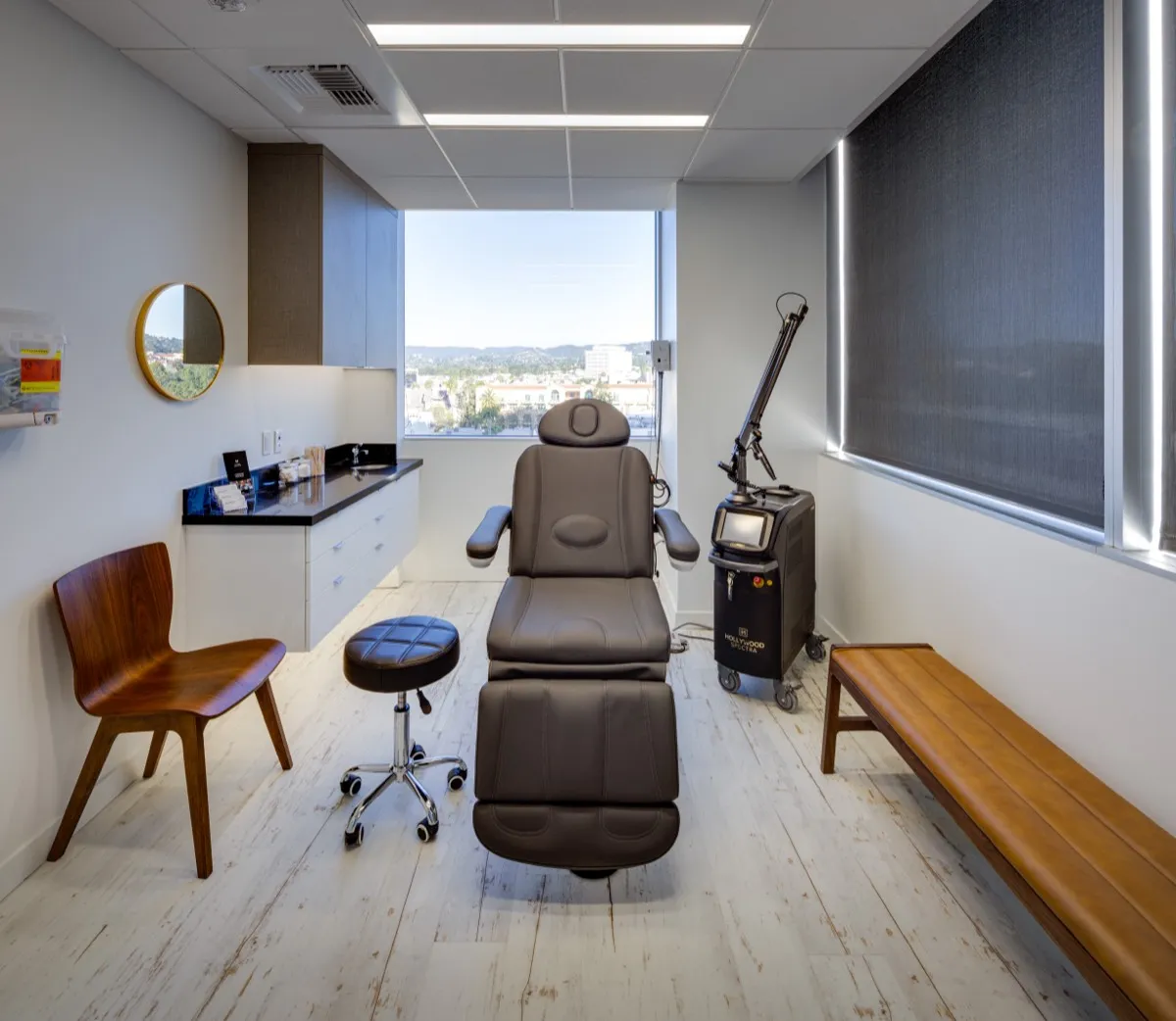
- Spectra MDFSpectra MDF provides fractional laser treatment with less recovery than traditional ablative CO2 resurfacing. It can be used for selected concerns involving texture, scars, pores, and uneven tone. It runs on the Hollywood Spectra laser (Lutronic), FDA-cleared in February 2022 (510(k) K213569) for skin resurfacing procedures for the treatment of acne scars and wrinkles. Surgical, injury, and raised scars are not a cleared use of this device. The same laser is cleared to treat post-inflammatory hyperpigmentation, the dark marks inflammation can leave. Available at: Downtown LA, Brentwood, Pasadena, San Jose.
- UltraClearStudied in Fitzpatrick skin types II to IV, UltraClear scar treatmentStudied scar treatment UltraClear is a customizable fiber laser that can treat skin at different depths and levels of intensity. Depending on the selected mode, it may be used for pigmentation, uneven tone, texture, wrinkles, scars, and more advanced resurfacing. FDA-cleared in December 2021 (510(k) K210847) for general skin resurfacing and, in its Ultra mode, for scar revision (including acne scars) and keloids. Available at: Costa Mesa.
- eCO2 and EdgeOne CO2Studied in Fitzpatrick skin types III to IVStudied eCO2 and EdgeOne are fractional ablative CO2 lasers designed for more significant resurfacing. They may be considered for deeper texture irregularities, acne scars, wrinkles, and sun damage that may not respond sufficiently to gentler treatments. These treatments involve meaningful recovery. Depending on the depth and intensity, downtime is often a week or longer. The eCO2 3D (Lutronic) is FDA-cleared (510(k) K244060, July 2025) for resurfacing with its fractional handpieces, and for treating acne scars, surgical scars, and keloids with its non-fractional handpieces. The EdgeOne (Jeisys) is cleared (K162169, October 2016) for ablative skin resurfacing; scars are not named in its clearance. Available at: eCO2: Brentwood, San Jose. EdgeOne: Pasadena. Downtown LA uses the Alma Hybrid CO2 laser (Alma Lasers), FDA-cleared (K251230, May 2025) for skin resurfacing to treat acne scars, surgical scars, and keloids.
- Genius RF MicroneedlingStudied in Fitzpatrick skin types I to IVStudied Genius combines microneedling with radiofrequency energy delivered beneath the skin's surface. Genius may be used for acne scars, uneven texture, enlarged pores, and mild skin laxity. FDA-cleared (510(k) K253484, June 2026) for electrocoagulation, contraction, and hemostasis in dermatologic procedures. Treating scars is not a cleared use; your provider explains why it may still be recommended. Available at: Downtown LA, Brentwood, Pasadena, San Jose. Costa Mesa offers RF microneedling on a different device.
- V-Laser and DermaVDermaV and V-Laser are designed to treat vascular and pigment-related concerns. Different wavelengths, pulse durations, and settings allow us to target visible blood vessels, persistent redness, and selected pigmentation with greater specificity. The V-Laser (WON TECH) is FDA-cleared (510(k) K231054, August 2023) for the reduction of red pigmentation in hypertrophic and keloid scars where vascularity is an integral part of the scar. The DermaV (Lutronic, K203788, March 2021) is cleared for vascular lesions; scars are not named, so treating a red scar with it is not a cleared use. Available at: V-Laser: Costa Mesa. DermaV: Downtown LA, Brentwood, Pasadena, San Jose.
FDA clearance status checked against FDA 510(k) records on 8 November 2026. Every device we use
Is it right for you
Who laser scar treatment suits, and who should wait.
Often a good fit
- Sunken scars and uneven texture, including acne scars
- Scars from surgery or injury, including recent ones
- Red or pink scars that have not faded
- Raised scars and keloids, usually alongside injections
- People who want a scar to be less noticeable and can wait months for the result
Not a fit, or wait
- A tan or sunburn on the day of treatment
- Isotretinoin now or in the last 6 months, for laser resurfacing
- Smoking: stop at least 2 weeks before
- Retinoid or glycolic acid skincare: stop 2 to 4 weeks before, as directed
- A keloid you hope to remove completely: lasers flatten and fade, and keloids can return
Tell us first if you get cold sores, have diabetes or another medical condition, or take vitamin E, aspirin, or supplements that can delay healing. Do not stop a prescribed medicine without asking the doctor who prescribed it.
Timing matters after isotretinoin. The medication label advises waiting at least 6 months before laser resurfacing or dermabrasion; some gentler treatments may be possible sooner, and your dermatologist will time each step.
Darker skin tones
Laser scar treatment for darker skin tones.
Skin type is one of the first considerations in any laser treatment, not a footnote. Different wavelengths and technologies interact with pigment, blood vessels, water, and tissue in different ways. The device matters, but so do the settings, technique, and experience of the person using it.
Darker skin is more prone to burns and dark marks after laser treatment, and the skin can also turn lighter. In one study of 82 people with skin types III and IV treated with a fractional CO2 laser, about 7 in 10 had temporary darkening afterward, and in about 1 in 3 it lasted longer than three months.
Darker skin also scars differently. Black patients have the highest risk of keloids, and people of Asian, Latin American, or Mediterranean descent are also more likely to form them than people with lighter skin.
In deeper skin tones, the choice of device and settings affects the risk of dark marks. Radiofrequency energy is not absorbed by skin pigment the way laser light is, which may lower the risk of dark marks in deeper skin tones.
Proper scar classification and careful application are especially important in patients prone to post-inflammatory pigmentation.
Our technology was selected to treat a broad range of skin tones and concerns thoughtfully. If the treatment you requested is not appropriate for your skin, we will explain why and recommend a safer or more effective alternative.
Skin types on the Fitzpatrick scale, from I (lightest) to VI (deepest). Filled numbers are the types each treatment is cleared, treated, or studied for. Ranges for a treatment in general and for a specific device can differ, because they come from different studies. Your provider confirms the right approach for your skin at your visit.
Your plan
What a laser scar treatment plan involves.
ConsultationWe identify the scar type and what creates its appearance, then choose the device, depth, and settings
BeforeNo tan or sunburn; pause retinoid and glycolic products and smoking as directed
SessionsOften a series; the number depends on the scar and the device
RecoveryFrom little downtime with gentler nonablative lasers to a week or longer with CO2
ResultsBuild over months; little change at first is common
AfterwardProtect the treated skin from the sun until it heals
A single treatment may be enough. In other cases, carefully combining treatments at different depths can create a more complete result.
Risks
Laser scar treatment risks and side effects.
Most reactions are short-lived. This list is not complete; your provider reviews the risks for your device and skin.
| Effect | What to know |
|---|
| Redness and swelling | Common after fractional lasers, and temporary. |
| Downtime | Little with gentler nonablative lasers; often a week or longer after CO2 resurfacing. |
| Darker or lighter skin, burns | More likely in darker skin. Darkening is often temporary but can last months. |
| A new or worse scar | Reported after fractional lasers. Treating a keloid the wrong way can enlarge it. |
| A keloid coming back | No treatment always prevents a keloid from returning. |
Other options
Other scar treatments, and when they fit better.
Scar treatments that are not lasers
| Treatment | Where it fits | Good to know |
|---|
| Steroid injections | Raised scars and keloids | Between 50% and 80% of keloids shrink after injection; often paired with laser |
|---|
| Silicone gel sheets | Raised scars | Sheets appear to work better than silicone ointment |
|---|
| TCA CROSS for scars | Deep, narrow acne scars | Treats one scar at a time; not FDA-approved for scars |
|---|
| Subcision with PRP or Sculptra | Sunken scars held down beneath the skin | Releases the bands so the scar can lift |
|---|
| RF microneedling | Sunken acne scars and texture | Heat beneath the surface, at selected depths |
|---|
| Cutting out a keloid | Only with other treatment | Nearly all keloids return after surgery alone |
|---|
Many scars respond better to a combination of treatments than to a laser alone.
Questions
Laser scar treatment questions.
Can a laser remove a scar completely?
No. A laser cannot get rid of a scar; it replaces it with a less noticeable one. How much it improves depends on the type of scar.
How many laser sessions does a scar need?
Often more than one, as a series. Results build over months, so the number is set at your consultation once we know the scar type and device.
My mole removal scar is still red. Will it fade?
Usually. Redness can take a number of months to fade, and a scar can take 12 to 18 months to settle. If it stays red, a vascular laser can target the blood vessels in it. Red scars after mole removal
How soon after surgery can a scar be treated?
Earlier tends to help most. In a 2025 review, fractional CO2 laser started within about a month of surgery reduced scarring. Your dermatologist times it to how the wound is healing.
Can lasers treat keloids?
Yes, as part of a plan. A laser can lower a keloid's height and fade its color, and two or more treatments, such as laser with steroid injections, often work better than one. Treating a keloid the wrong way can enlarge it, and no treatment always keeps one from returning.
Is laser scar treatment safe for darker skin?
It can be done carefully, with the device and settings chosen for your skin. Darker skin is more prone to burns and dark marks after laser treatment, which is why skin type comes first in the plan. Darker skin tones
Is laser scar treatment covered by insurance?
Insurance is accepted for eligible medical care. Health insurance generally does not cover cosmetic treatments, so our team confirms costs before your first session.
How much does laser scar treatment cost?
Plans and costs are set at your consultation, once we know what you want to change and which treatments fit.
Sources: FDA 510(k) clearances for Hollywood Spectra, UltraClear, eCO2 3D, EdgeOne, Alma Hybrid, Genius, V-Laser and DermaV; American Academy of Dermatology on laser scar treatment and keloids; Fu and colleagues, 2019.