What it is
What the Alma Hybrid laser is.
The Alma Hybrid Laser System is made by Alma Lasers, which holds both of its FDA clearances. It is a fractional laser: it treats the skin in a grid of microscopic zones and leaves the skin between them untouched.
"Hybrid" refers to its two wavelengths: an ablative CO2 laser and a nonablative 1570 nm laser. Its ProScan applicator can fire them side by side in one pass, a pattern Alma calls HyGrid. Its other two applicators, Pixel and HyLight, use CO2 alone.
2 wavelengthsCO2 (10,600 nm) and 1570 nm
FDA-cleared510(k) K251230, May 2025; first cleared in 2021 (K203441)
1 officeDowntown LA
3 applicatorsPixel, HyLight, and ProScan
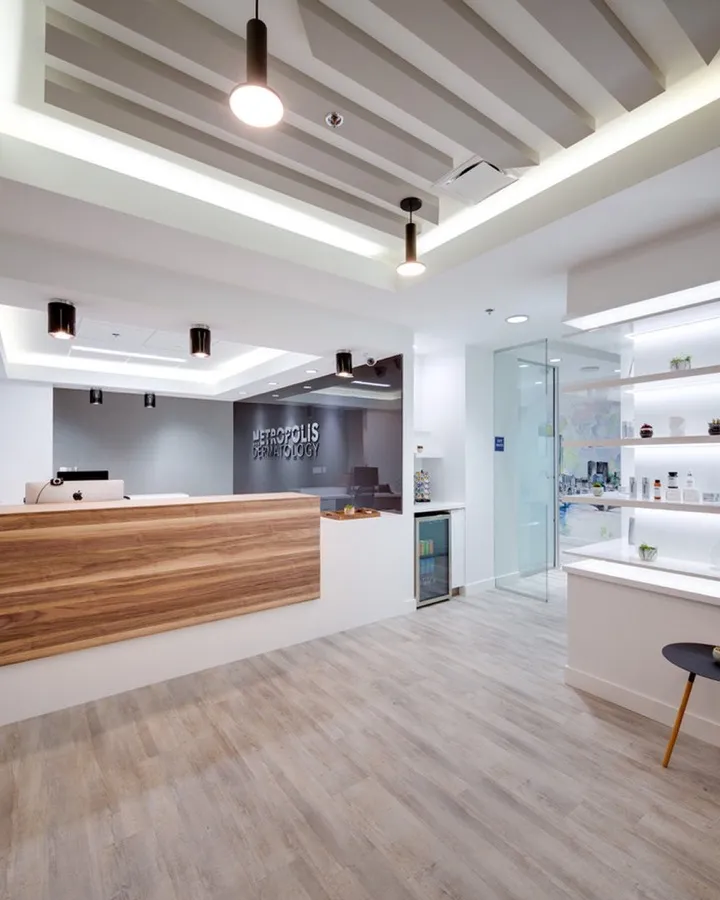
At Metropolis Dermatology, the Alma Hybrid is offered at our Downtown LA office, which serves one of the most diverse patient populations in the practice. Our other CO2 resurfacing lasers are the eCO2 in Brentwood and San Jose and the EdgeOne in Pasadena; both are on our eCO2 and EdgeOne page.
How it works
How Alma Hybrid laser resurfacing works.
CO2: removes tiny columns
The CO2 beam, at 10,600 nm, is absorbed by water in the skin. The heat vaporizes microscopic columns of tissue, an ablative effect, and the skin heals in from the untouched skin around them.
1570 nm: heats without removing
The 1570 nm beam heats columns of skin and leaves the surface in place, a nonablative effect. In its first clearance, the FDA compared it with a 1565 nm fractional laser from another maker.
Three applicators
Pixel delivers fractional CO2 through a grid of tiny dots. HyLight delivers a solid CO2 beam, from a fine point up to about 3 mm. ProScan scans a fractional pattern of CO2, 1570 nm, or both, over an area up to 30 mm across.
Collagen
As the skin heals, it remodels. The FDA clearance for the Alma Hybrid states that clinical literature shows CO2 resurfacing of wrinkles increases the amount of collagen beneath the skin's surface.
We select the technology, wavelength, depth, and settings based on your skin rather than asking your skin to fit a particular device.
FDA clearance
What the Alma Hybrid is FDA-cleared for, and what it is not.
Lasers are FDA-cleared, not FDA-approved: the FDA found each device equivalent to one already on the market, for the specific uses named in its clearance. Where a use is not named, we say so.
Skin uses, the Alma Hybrid clearance (510(k) K251230, May 21, 2025), and where to read more
| Use | FDA clearance | Read more |
|---|
| Wrinkles, fine lines, and texture | Cleared with the Pixel and HyLight CO2 applicators: laser skin resurfacing for "wrinkles, rhytids, and furrows," including fine lines and texture irregularities | Skin resurfacing |
|---|
| Acne scars | Cleared with the Pixel and HyLight CO2 applicators | Laser scar treatment; acne scarring |
|---|
| Surgical scars and keloids | Cleared with the Pixel and HyLight CO2 applicators | Laser scar treatment |
|---|
| Sun damage and uneven pigmentation | Cleared with the Pixel and HyLight CO2 applicators: solar elastosis, uneven pigmentation, and lentigines (sun spots) | Skin resurfacing |
|---|
| ProScan, CO2 and 1570 nm together | Cleared for laser skin resurfacing. No specific skin concern is named for this applicator | How it works |
|---|
| ProScan, 1570 nm alone | Cleared for "fractional skin resurfacing and coagulation of soft tissue." No specific skin concern is named | How it works |
|---|
| Skin tightening or lifting | Not a cleared use. Not named in the clearance | Skin tightening |
|---|
| Melasma | Not a cleared use. Not named in the clearance | Melasma treatment |
|---|
So the concerns named above are cleared uses with the Pixel and HyLight CO2 applicators. The published studies used the ProScan applicator, whose clearance says skin resurfacing without naming a concern; when a use is not named, your provider explains why the Alma Hybrid may still be recommended for you.
The Alma Hybrid was first FDA-cleared in July 2021 (510(k) K203441). The May 2025 clearance added wrinkles, surgical scars, keloids, sun damage, and uneven pigmentation, among other uses, for its Pixel and HyLight CO2 applicators. Neither clearance relied on new studies in people; the FDA compared the laser with earlier Alma lasers and another maker's laser.
The clearance also covers many surgical uses, such as removing skin growths and warts, and eyelid surgery. This page covers resurfacing. For treating a specific scar, see laser scar treatment; for lines, sun damage, and texture across all our lasers, see skin resurfacing.
FDA clearance status checked against FDA 510(k) records on 8 November 2026. Every device we use
Is it right for you
Who Alma Hybrid laser treatment suits, and who should wait.
Often a good fit
- Fine lines, wrinkles, and rough texture
- Acne scars and surgical scars, as one part of a scar plan
- Sun damage and uneven pigmentation, once a dermatologist has confirmed the spots are harmless
- You want more change than a gentle laser gives, and you can plan for several days of recovery
Not a fit, or wait
- A tan or sunburn on the area on the day of treatment
- Isotretinoin now or in the last 6 months
- Smoking: stop at least 2 weeks before
- A history of cold sores: tell us first, because medicine to prevent an outbreak is recommended
- Melasma: an overly aggressive treatment can trigger rebound pigmentation and leave the skin darker than before
- A raised scar or keloid: we assess the scar type first, because the wrong treatment can make a keloid worse
- A spot that has not been checked: confirmed harmless first, treated second
Timing matters after isotretinoin. The medication label advises waiting at least 6 months before laser resurfacing or dermabrasion; some gentler treatments may be possible sooner, and your dermatologist will time each step.
The right treatment is not automatically the strongest one. It is the one that appropriately balances the amount of correction your skin needs with the downtime, risk, and recovery you can accommodate.
Darker skin tones
Alma Hybrid laser on darker skin tones.
Skin type is one of the first considerations in any laser treatment, not a footnote. Different wavelengths and technologies interact with pigment, blood vessels, water, and tissue in different ways. The device matters, but so do the settings, technique, and experience of the person using it.
Neither FDA clearance for the Alma Hybrid names skin types. Darker skin is more prone to burns and dark marks after laser treatment, and the main risks are burns, blistering, and patches that turn lighter or darker than the surrounding skin. A recent tan raises the risk further.
With ablative lasers such as CO2, people with darker skin have a higher risk of uneven color and of scarring. Nonablative treatments generally have a more favorable safety profile, particularly in skin of color.
The published studies of this laser that report skin type included only types II to IV. They were small, and none compared the Alma Hybrid with another laser, so they say little about deeper skin tones and are a reason for care rather than a promise.
Both the energy and the density of a fractional treatment affect the risk of dark marks, which is why settings are chosen for your skin rather than taken from a standard menu. Aggressive resurfacing without a plan can make it worse.
Our technology was selected to treat a broad range of skin tones and concerns thoughtfully. If the treatment you requested is not appropriate for your skin, we will explain why and recommend a safer or more effective alternative.
Your plan
Your Alma Hybrid treatment plan.
Tell us what you notice, what you want to change, and how much downtime you can accommodate. We will evaluate the rest and build a plan around you.
ConsultationWe find what is causing the lines, texture, or scar, check your skin type, and decide whether the Alma Hybrid, and which applicator, is the right tool
BeforeNo tan or sunburn; tell us about cold sores and isotretinoin; stop smoking as directed
ComfortThe skin is numbed first. In a published study of treatment around the eyes, a local anesthetic was injected beforehand and protective eye shields were placed
SessionsOften one to three. Studies used a single treatment around the eyes, one to three for the face, and three sessions two months apart for acne scars; your provider sets the number
The first daysRedness, swelling, and crusting are expected. In the study around the eyes, people returned to social activities after about 6 days on average, and redness took about 18 days to fade
SunProtect the treated skin from the sun until it heals; in the study around the eyes, patients used SPF 50 sunscreen for 3 months
ResultsBuild gradually as collagen remodels; it can take months to see results
Other lasers
Alma Hybrid or another resurfacing laser?
Technology provides options. Knowing which device to use, and how to use it, is what makes those options meaningful.
Our lasers for texture, scars, and tone, compared
| Device | What it is used for | Recovery |
|---|
| Alma Hybrid | Fractional CO2, 1570 nm, or both in one pass, for lines, texture, sun damage, and scars | About 6 days to social activities after one treatment around the eyes, in one study |
|---|
| eCO2 and EdgeOne CO2 | Significant texture irregularity, scarring, or sun damage that has not responded to gentler options | Often a week or longer, depending on depth and intensity |
|---|
| Spectra MDF | Fractional resurfacing, a middle option for early texture change or uneven tone | Less downtime than eCO2 |
|---|
| LaseMD Ultra | A fractional pattern of microscopic channels, leaving the surrounding skin intact | Redness typically settles within a day |
|---|
| Genius RF Microneedling | Acne scars, uneven texture, enlarged pores, and mild skin laxity | Depth and settings are adjusted for the concern, area, and skin type |
|---|
| UltraClear (Costa Mesa) | Pigmentation, uneven tone, texture, wrinkles, scars, and more advanced resurfacing, depending on the mode | Adjusted with the degree of treatment |
|---|
Alma Hybrid: Downtown LA. eCO2: Brentwood and San Jose. EdgeOne: Pasadena. Spectra MDF, LaseMD Ultra and Genius: Downtown LA, Brentwood, Pasadena, San Jose. UltraClear: Costa Mesa. All our technology
Risks
Alma Hybrid laser risks and side effects.
Most reactions are short-lived. This list is not complete; your provider reviews the risks for your skin and the applicator used.
| Effect | What to know |
|---|
| Redness, swelling, crusting | Expected. In one study of this laser around the eyes, everyone had redness, which took about 18 days on average to fade; about half had crusting; 5 of 24 had swelling that lasted longer and was gone within 30 days. |
| Darker or lighter skin, burns | Among the most common lasting complications of laser treatment, and more likely in darker skin. In the same study, 4 of 24 people had darker patches, which faded within 30 days. |
| Cold sore outbreak or infection | More likely with ablative lasers, while the surface heals. Tell us if you get cold sores. |
| Scarring | One of the most serious complications. The risk is higher with ablative lasers and in darker skin. |
| Less change than hoped | A laser cannot get rid of a scar; it replaces it with a less noticeable one, and improvement builds slowly. |
Call us if, after treatment, pain keeps getting worse, or you notice blisters or grey patches on the treated skin.
Related: Clarity II, Hollywood Spectra
Questions
Alma Hybrid laser questions.
What is the Alma Hybrid laser?
It is a fractional resurfacing laser from Alma Lasers with two wavelengths: an ablative CO2 laser and a nonablative 1570 nm laser, which it can use alone or together. At Metropolis Dermatology it is offered in Downtown LA for lines, texture, sun damage, and scars.
Is the Alma Hybrid a CO2 laser?
Yes, in part. Its Pixel and HyLight applicators use CO2 alone, at 10,600 nm. Its ProScan applicator can use CO2, a 1570 nm wavelength, or both in one pass.
What is the Alma Hybrid FDA-cleared for?
It was FDA-cleared in May 2025 (510(k) K251230). With its Pixel and HyLight CO2 applicators, the cleared skin uses include resurfacing for wrinkles, fine lines and texture irregularities, sun damage (solar elastosis), uneven pigmentation, acne scars, surgical scars, and keloids. With its ProScan applicator, the clearance is for skin resurfacing, without naming a specific concern. Skin tightening is not a cleared use. What it is cleared for
What is the clinical advantage of the Alma Hybrid?
Choice within one laser: CO2 for deeper resurfacing, 1570 nm for gentler heating, or both in one pass, so the depth and the recovery can be matched to your skin. In one study of a hybrid CO2 and 1570 nm laser, two or three treatments at lower settings averaged about 4 days of downtime, against about 7 days for one treatment at high settings, and both groups improved. The studies are small, and none compared the Alma Hybrid with another laser.
How does it compare with other skin rejuvenation options?
Skin resurfacing exists along a spectrum. Gentle nonablative treatments may require little downtime and produce gradual improvement, while deeper ablative treatments, including fractional CO2 resurfacing, can create more significant change but require more recovery. The right treatment is not automatically the strongest one. Our lasers compared
How long is recovery after Alma Hybrid laser treatment?
It depends on the applicator, the settings, and the area. In a study of a single treatment around the eyes, people returned to social activities after about 6 days on average, and redness took about 18 days to fade. In another study of a hybrid CO2 and 1570 nm laser, lower settings over two or three sessions averaged about 4 days of downtime. Your provider tells you what to plan for before you book.
How many sessions will I need?
Studies used one treatment around the eyes, one to three treatments for the face, and three sessions two months apart for acne scars. Your provider sets the number at your consultation.
Do you have Alma Hybrid before and after photos, or reviews?
Metropolis before and after photos are in our gallery, shown with each patient's consent, and patient reviews are on what patients say. Results vary, and for scars the goal is a less noticeable scar, not one that is gone.
How much does Alma Hybrid laser treatment cost?
Plans and costs are set at your consultation, once we know what you want to change and which treatments fit.
Is the Alma Hybrid suitable for darker skin?
It can be used carefully, with the applicator, energy, and density chosen for your skin. The clearance names no skin types, darker skin is more prone to burns and dark marks after laser treatment, and the studies of this laser included skin types II to IV only, which is why skin type comes first in the plan. Darker skin tones
Who can perform Alma Hybrid treatment?
Its FDA clearance is for prescription use. At Metropolis, treatment starts with an evaluation by our dermatology team, and we confirm which clinician performs it when you book.
Where can I get the Alma Hybrid in Los Angeles?
At our Downtown LA office, 888 S. Figueroa St, Suite 1050, Los Angeles, CA 90017. Our Brentwood, Pasadena, and San Jose offices offer CO2 resurfacing on other lasers. Where to go
Is it covered by insurance?
Insurance is accepted for eligible medical care. Health insurance generally does not cover cosmetic treatments, so our team confirms costs before your first session.
Sources: FDA 510(k) K251230 and K203441, The Alma Hybrid Laser System; Tsur Shenhav and colleagues, dual CO2 and 1570 nm hybrid laser around the eyes (2023); García and Andrino, acne scars (2024); Shenhav and colleagues, single versus multiple sessions (2024); American Academy of Dermatology on laser scar treatment and skin conditions lasers can treat; Nguyen and colleagues, complications of laser procedures (2026); Harnchoowong and colleagues, dark skin (2024); Fu and colleagues, 2019.