(213) 319-3339Dermatologist in Downtown LA
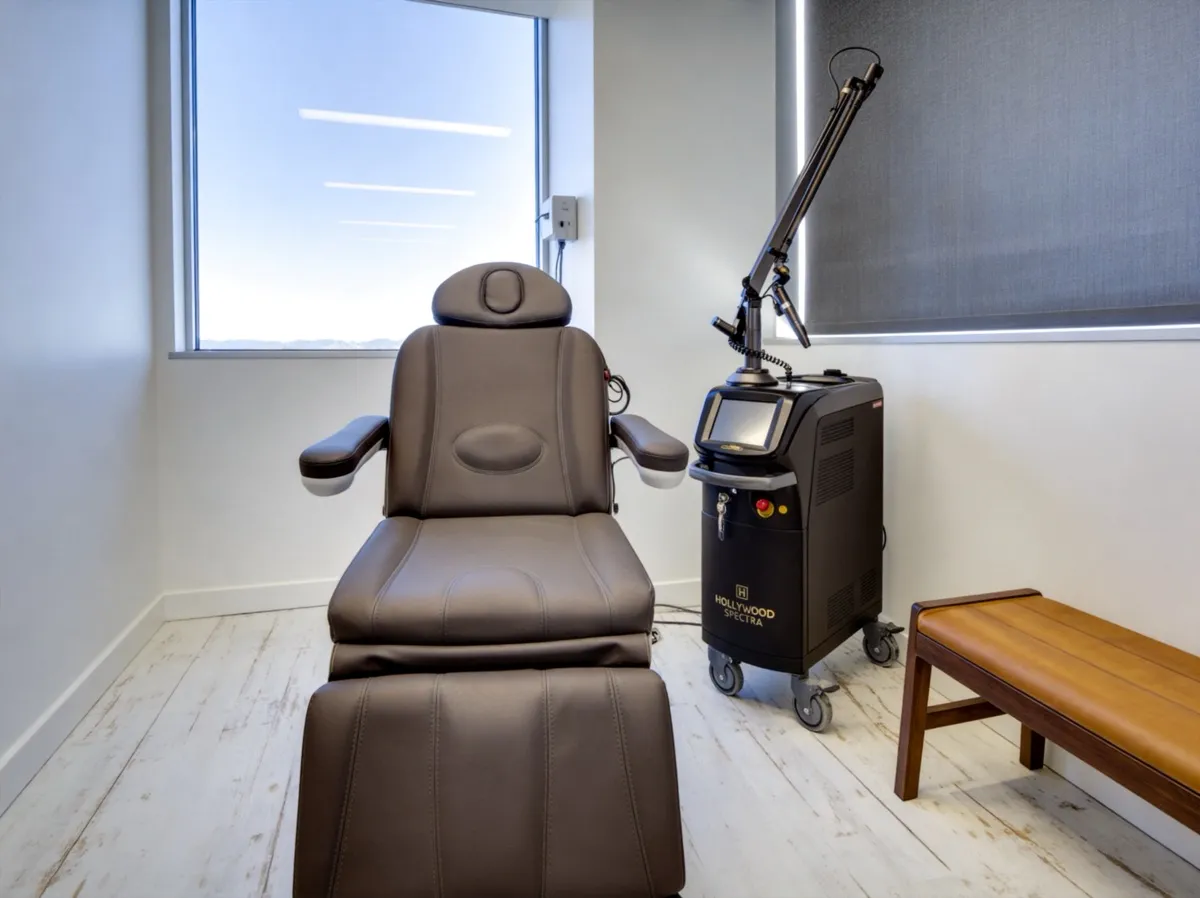
Hollywood Spectra is a versatile pigment-focused laser. By changing the wavelength, handpiece, and settings, we can address concerns such as unwanted pigmentation, uneven tone, and selected tattoos, and perform a low-downtime carbon laser facial.
The FDA clearance names no skin types. Studies cover some uses in some skin types, listed by use below.

Hollywood Spectra is available at our Downtown LA, Brentwood, Pasadena, and San Jose offices.
Your plan and cost are set at your consultationHollywood Spectra is a Q-switched Nd:YAG laser made by Lutronic, now part of Cynosure Lutronic. It produces two wavelengths, 1064 nm and 532 nm, in nanosecond pulses, plus a long-pulse mode, and it was FDA-cleared in 2022 for a range of pigment, tattoo, vascular, and resurfacing uses.
In its nanosecond mode, each pulse lasts billionths of a second. Pigment and tattoo ink absorb the energy and heat up so fast that they break into smaller particles. A separate long-pulse mode treats wrinkles and acne.
The 1064 nm beam is cleared for melasma, Nevus of Ota, and dark inks. The 532 nm beam is cleared for surface spots and lighter inks.
A zoom handpiece sets the spot size, a microbeam handpiece treats in a pattern of fine dots, and dye handpieces convert the 532 nm light to 585 nm or 650 nm.
We select the technology, wavelength, depth, and settings based on your skin rather than asking your skin to fit a particular device.
These are the uses Metropolis lists for Hollywood Spectra, each matched to its FDA-cleared indication and the evidence behind it.
| Use | What it is for | FDA clearance | Skin type |
|---|---|---|---|
| Carbon laser facial (Hollywood peel) | Pores, glow, acne, and dark marks after acne | No FDA indication names the carbon facial. It uses the Q-switched 1064 nm beam over a carbon layer, and published studies are few | — |
| Melasma (laser toning) | Brown patches on the cheeks, forehead, and lip | Cleared, 1064 nm | Studied in Fitzpatrick skin types II to VStudied |
| Sun spots and freckles | Surface brown spots (lentigines), freckles | Cleared, 532 nm | — |
| Dark marks after acne | Post-inflammatory hyperpigmentation | Cleared, 532 nm | — |
| Tattoo removal | Dark inks (black, blue, brown) and lighter inks (red, orange, purple, green, sky blue) | Cleared, 1064 nm and 532 nm | — |
| Pores and texture | Enlarged pores, early texture change, acne scars | Resurfacing for acne scars and wrinkles is cleared with the microbeam handpieces; pores and texture are not cleared uses | — |
Skin type: "Studied" means peer-reviewed studies included those types for that use; patients in the melasma review were mostly types II to V, and types I and VI were rarely studied, which is not the same as unsafe. "Provider assesses" means no reliable source states a range, so your provider decides with you.
The right choice depends on what is causing the pigment and how deep it sits, which is why we start with a diagnosis rather than a device.
Each device has a different purpose. Technology provides options. Knowing which device to use, and how to use it, is what makes those options meaningful.
| Device | What it is used for | Recovery |
|---|---|---|
| Hollywood Spectra | Pigment, tone, tattoos, and the carbon laser facial | Low for the carbon facial; varies by use |
| Spectra MDF | Fractional resurfacing for early texture change or uneven tone | Less downtime than eCO2 |
| LaseMD Ultra | Gentle fractional treatment for pigmentation, sun damage, and uneven tone | Redness typically settles within a day at lighter settings; stronger settings can mean several days |
| DermaV | Vessels, pigment, and general revitalization | Depends on the setting |
| eCO2 | Significant texture, scarring, or sun damage (scar uses depend on the model and handpiece) | Real downtime, typically a week or more |
| Chemical peels | Texture, pores, melasma, dark marks, and acne, without a device | Depends on the strength of the peel |
Costa Mesa does not have Hollywood Spectra; ask the office which laser fits your concern. All our technology.
| Effect | What to know |
|---|---|
| Redness after treatment | Expected for a short time after treatment. |
| Light spots | With repeated melasma toning, small pale spots can develop and persist; about 10% in studies of East Asian patients, more often in darker skin and with too much total energy. We use spacing and settings to limit this. |
| Darker patches | Aggressive treatment can darken melasma or leave dark marks, especially in darker skin. |
| Melasma coming back | Melasma often returns after treatment stops; in one study, about 59% had relapsed at one year. Ongoing sun protection and skincare matter. |
| Tattoos | Removal takes many sessions, weeks apart. |
A Q-switched Nd:YAG laser from Lutronic with two wavelengths, 1064 nm and 532 nm. We use it for unwanted pigment, uneven tone, selected tattoos, and the carbon laser facial.
Yes. It was FDA-cleared in February 2022 (510(k) K213569) for uses including melasma, sun spots, dark marks after inflammation, tattoo removal, minor vessels, and resurfacing for acne scars and wrinkles.
It depends on what you want to treat. Hollywood Spectra was FDA-cleared in February 2022 for uses including melasma, sun spots, dark marks after inflammation, tattoo removal, minor vessels and resurfacing for acne scars and wrinkles. Published studies on the carbon laser facial are still limited, and melasma toning studies mostly included skin types II to V. We start with a diagnosis rather than a device, so the right laser is the one that fits your concern.
It is the carbon laser facial: a thin layer of carbon goes on the skin, and the laser passes over it. The treatment creates a mild warming sensation and takes under 30 minutes. People choose it for pores, acne, and a brighter look with low downtime. Published studies are still limited.
Most treatments last 30 minutes or less, which makes them easy to fit into a lunch break or before an event. The time depends on the use.
People choose the carbon laser facial for pores, acne, dark marks after acne and a brighter look with low downtime. No FDA indication names the carbon facial, and published studies are few, so we describe it as a low-downtime option and set expectations at your consultation.
In studies, usually about 9 to 10 low-energy sessions, weekly or every two weeks. In studies, adding skincare or, for some patients, medication generally lowered side effects, though it did not always improve results.
It may. Melasma often returns after treatment stops; in one study, about 59% had relapsed at one year. Daily sun protection and maintenance skincare are part of the plan.
It is FDA-cleared for tattoo removal. The 1064 nm beam is cleared for dark inks and the 532 nm beam for lighter inks such as red, orange, and green. Removal takes many sessions, weeks apart, because the ink sits in layers.
The FDA clearance names no skin types, so your provider assesses your skin. Melasma toning studies mostly included types II to V, and the risk of light spots or darker patches is higher in darker skin, so we use lower energy and careful spacing.
Hollywood Spectra is used for pigment, tone, tattoos, and the carbon facial. Spectra MDF is our fractional resurfacing option for early texture change or uneven tone, with less downtime than eCO2.
Hair removal is not one of the uses we list for Hollywood Spectra. On this page the Hollywood peel is the carbon laser facial, and the laser's clearance covers pigment, tattoo, vascular and resurfacing uses. If you are looking for laser hair removal, ask us about it separately.
Downtown LA, Brentwood, Pasadena, and San Jose. In Costa Mesa, ask the office which laser fits your concern.
Cost depends on what we are treating and how many sessions your plan needs, so we quote it at your consultation, before you start.
It depends on the use. The carbon laser facial has low downtime, and you may have some redness or warmth afterward that typically resolves quickly. Tattoo removal and melasma toning follow their own healing and spacing.
Many patients notice an immediate improvement in skin brightness and texture after the carbon laser facial. Deeper concerns like melasma or tattoos take several sessions for the full result.
Sources: FDA 510(k) K213569, Hollywood Spectra, Lee et al., low-fluence Nd:YAG for melasma, systematic review (2022), Guida et al., carbon peel laser technique (2020), and American Academy of Dermatology on tattoo removal.
Hollywood Spectra is available at four of our five offices.


In Costa Mesa, ask the office which laser it uses for these concerns. What patients say.
6 dermatologists, 7 physician assistants and nurse practitioners. We match you with a provider based on your concern and each provider's clinical focus.


No providers listed for this office yet. See the full team.
Share what is happening with your skin and where you would like to go from here. We will help match you with the right provider and type of visit.