What can change
Enlarged pore treatment in Los Angeles: what can and cannot change.
No laser changes a pore's actual size in the short term. What is immediately achievable is reducing the oil and debris that make pores look larger, and that effect needs maintenance over time. However, over the long run, with persistence and a good plan, we can rebuild collagen in a way that can shrink pores.
Over time, treatments that improve oil control, texture, and collagen support can make pores appear smaller. Results usually come from a consistent plan rather than a single procedure.
Not erasedNo treatment removes pores for good
Right awayCleaner pores and smoother skin
Over monthsA plan, often several sessions, then maintenance
Five officesThe treatments offered differ by office
Large pores have more than one cause, so a dermatologist starts by finding what makes yours look larger: oil, clogged pores, sun damage, or skin that has lost firmness. The treatment follows the cause.
Enlarged pore treatment is offered at all five Metropolis offices: Downtown Los Angeles, Brentwood, Pasadena, Costa Mesa in Orange County, and San Jose. Chemical peels are offered at every office, and Spectra MDF and Genius RF microneedling at every office except Costa Mesa.
Acne clogs pores and makes them more noticeable, so when breakouts or very oily skin are part of the picture, controlling them is part of the plan. Start with acne and acne scarring if breakouts are still active.
Why pores look larger
What makes pores look larger, and open pores more visible.
Pores are the openings of the hair follicles, where the skin's oil reaches the surface. Dermatologists describe three main reasons they look enlarged: high oil production, loss of firmness in the skin around each pore, and larger hair follicles.
What makes pores look larger, and what helps each cause
| Cause | What happens | What helps |
|---|
| Oily skin | An oily complexion makes pores look larger | Gentle twice-daily cleansing, a retinoid, oil-controlling treatment |
|---|
| Clogged pores and acne | Clogged pores expand, and inflamed skin makes pores more noticeable | Treating acne, salicylic acid, professional extraction |
|---|
| Sun damage | The more sun damaged the skin, the less firm it is | Sunscreen every day; treatments that rebuild collagen |
|---|
| Aging | Skin loses firmness and sags, and pores look larger | Treatments that rebuild collagen, over months |
|---|
| Genetics, sex, and hormones | Affect pore size | Cannot be changed; treatment works on the other causes |
|---|
| Rough handling | Hot water, scrubbing, and picking irritate skin and make pores look larger | A gentle routine, hands off |
|---|
The focus shifts with age. A 2023 review of 19 clinical trials concluded that in younger people treatment should focus on controlling oil, and in older people on rebuilding firmness as well as controlling oil.
One large pore that looks like a blackhead
A single pore that is much larger than the others, with a dark plug like a blackhead, may be a dilated pore: a benign growth of the hair follicle, seen most often on the face and neck of middle-aged and older adults. Do not squeeze it. Surgical removal treats it, and a dermatologist confirms what it is first. Book a skin check
What helps at home
How to make large pores look smaller at home.
You cannot shrink a pore for good at home, but with the right skin care you can make pores less noticeable.
A retinoid at nightRetinol or retinyl palmitate may help when oily skin, mild acne, or less firm skin makes pores look larger; apply at bedtime
Salicylic acidA salicylic acid cleanser can unclog pores
Gentle cleansingTwice a day, without hot water or scrubbing
Non-comedogenic productsLabeled non-comedogenic, so they do not clog pores
Sunscreen every daySun damage takes away the firmness that keeps pores less visible
Hands offPicking at, squeezing, or digging into pores irritates skin and makes them more noticeable
Some people find retinol irritating. If you are pregnant or breastfeeding, do not use products with retinol or retinyl palmitate.
Prescription topical retinoids are also among the treatments dermatologists use for enlarged pores. Exfoliating may make pores less noticeable, but it has to be done safely to avoid damaging the skin, so ask us before adding a scrub or acid.
How it works
How in-office enlarged pore treatment works.
Clearing oil and debris
Chemical peels use carefully selected solutions to exfoliate the skin and improve concerns such as uneven tone, acne, congestion, and texture. Professional extraction can remove selected clogged pores while limiting unnecessary trauma to the surrounding skin.
Fractional laser
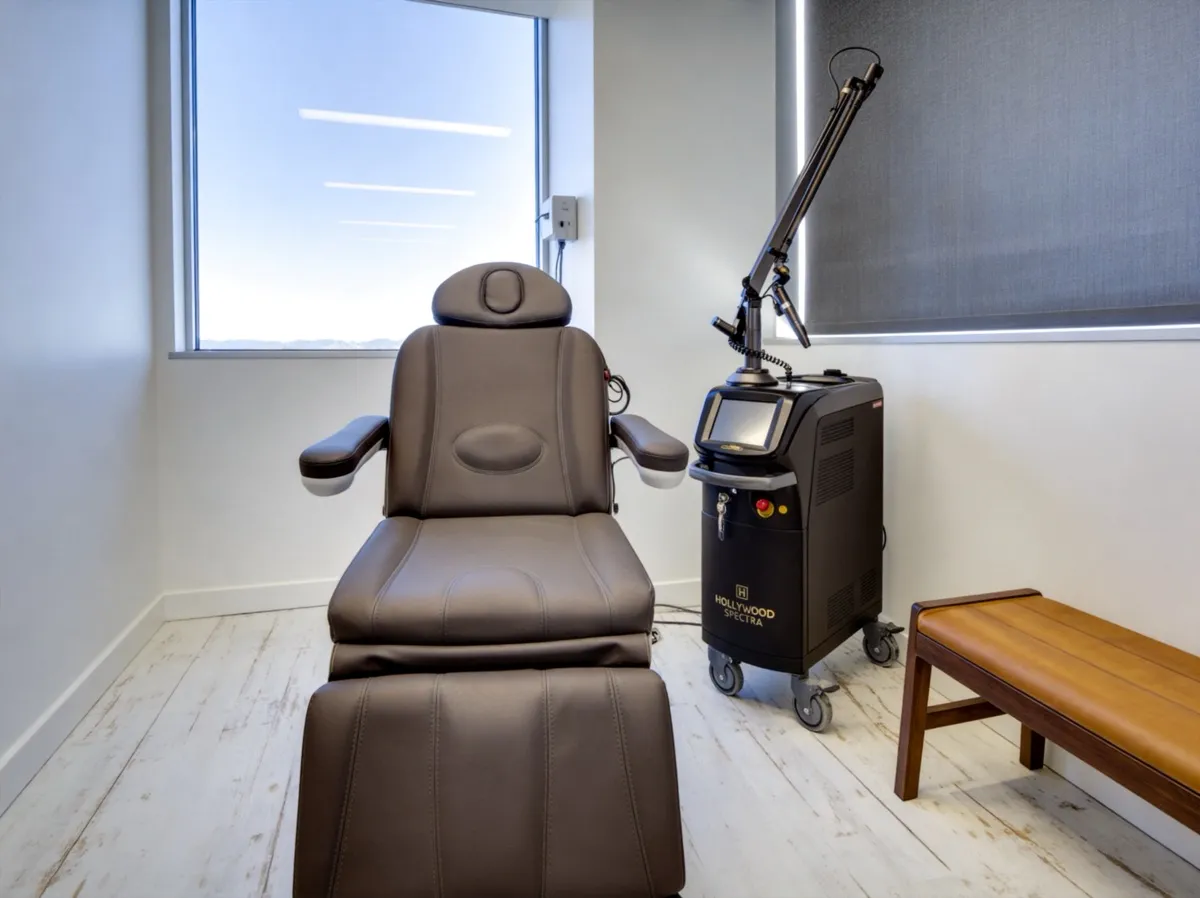
The laser makes microscopic columns of treated skin and leaves the skin between them alone. Healing remodels collagen. Spectra MDF provides fractional laser treatment with less recovery than traditional ablative CO2 resurfacing.
RF microneedling
Radiofrequency microneedling combines controlled microneedling with energy delivered beneath the skin's surface. This allows treatment at selected depths while stimulating collagen remodeling in the surrounding tissue.
Microneedling
Microneedling uses fine needles to create controlled microinjuries at a carefully selected depth. The skin's repair response gradually stimulates collagen remodeling and can improve acne scars, uneven texture, enlarged pores, and fine lines.
In a 2023 review of 19 clinical trials with 591 people, many treatments, from oral and topical medicines to lasers, reduced the number and size of visible pores. More than one session, and combining treatments, improved results.
In one trial of 80 people treated monthly for three sessions, both a fractional CO2 laser and a carbon-assisted Q-switched laser improved enlarged pores. The CO2 laser gave a larger, longer-lasting response; the Q-switched laser had less downtime.
In a study of 75 people treated with fractional RF microneedling for enlarged pores, improvement rose with the number of sessions.
The right treatment is not automatically the strongest one. It is the one that appropriately balances the amount of correction your skin needs with the downtime, risk, and recovery you can accommodate.
Our pore treatments
Pore treatments we use, and what each is FDA-cleared for.
Lasers are FDA-cleared, not FDA-approved: the FDA found each device equivalent to one already on the market, for the specific uses named in its clearance. No device we use names enlarged pores in its clearance, and we say so below.
- Spectra MDFSpectra MDF provides fractional laser treatment with less recovery than traditional ablative CO2 resurfacing. It can be used for selected concerns involving texture, scars, pores, and uneven tone. It runs on the Hollywood Spectra laser (Lutronic), FDA-cleared in February 2022 (510(k) K213569) for skin resurfacing procedures for the treatment of acne scars and wrinkles. Enlarged pores are not a cleared use of this device; your provider explains why it may still be recommended. Available at: Downtown LA, Brentwood, Pasadena, San Jose.
- Hollywood Spectra carbon laser facialThe Hollywood Spectra also performs the carbon laser facial, chosen by patients seeking a brighter, smoother appearance without traditional resurfacing. No FDA indication names the carbon facial or enlarged pores, and published studies are few. The same laser is FDA-cleared, in its long-pulse mode, for mild to moderate inflammatory acne (K213569). Available at: Downtown LA, Brentwood, Pasadena, San Jose.
- Genius RF MicroneedlingStudied in Fitzpatrick skin types I to IVStudied Genius combines microneedling with radiofrequency energy delivered beneath the skin's surface. Genius may be used for acne scars, uneven texture, enlarged pores, and mild skin laxity. FDA-cleared (510(k) K253484, June 2026) for electrocoagulation, contraction, and hemostasis in dermatologic procedures. Treating enlarged pores is not a cleared use; your provider explains why it may still be recommended. Available at: Downtown LA, Brentwood, Pasadena, San Jose. Costa Mesa offers RF microneedling on a different device.
- Chemical peelsPeels range in depth and intensity. Superficial peels generally involve little recovery, while deeper peels require medical evaluation, greater preparation, and more significant downtime. Available at: all five offices.
FDA clearance status checked against FDA 510(k) records on 8 November 2026. Every device we use
Is it right for you
Who enlarged pore treatment suits, and who should wait.
Often a good fit
- Pores that look larger because of oily skin or clogged pores
- Pores that look larger as skin loses firmness with sun damage or age
- People whose acne is treated or being treated alongside
- People who can commit to a series of visits and to maintenance
Not a fit, or wait
- A tan or sunburn on the day of laser treatment
- Isotretinoin now or in the last 6 months, for laser resurfacing
- Retinoid or glycolic acid skincare: pause 2 to 4 weeks before laser, as directed
- Pregnancy or breastfeeding: no retinol or retinyl palmitate products
- Hoping pores will disappear: no treatment erases them
Timing matters after isotretinoin. The medication label advises waiting at least 6 months before laser resurfacing or dermabrasion; some gentler treatments may be possible sooner, and your dermatologist will time each step.
Darker skin tones
Enlarged pore treatment for darker skin tones.
Skin type is one of the first considerations in any laser treatment, not a footnote. Different wavelengths and technologies interact with pigment, blood vessels, water, and tissue in different ways. The device matters, but so do the settings, technique, and experience of the person using it.
Darker skin is more prone to burns and dark marks after laser treatments.
On darker skin an overly aggressive peel can leave discoloration that takes months to settle. We choose depth accordingly.
In deeper skin tones, the choice of device and settings affects the risk of dark marks. Radiofrequency energy is not absorbed by skin pigment the way laser light is, which may lower the risk of dark marks in deeper skin tones.
Our technology was selected to treat a broad range of skin tones and concerns thoughtfully. If the treatment you requested is not appropriate for your skin, we will explain why and recommend a safer or more effective alternative.
Skin types on the Fitzpatrick scale, from I (lightest) to VI (deepest). Filled numbers are the types each treatment is cleared, treated, or studied for. Ranges for a treatment in general and for a specific device can differ, because they come from different studies. Your provider confirms the right approach for your skin at your visit.
Your plan
What an enlarged pore treatment plan involves.
ConsultationWe find what makes your pores look larger, then choose the treatment, depth, and settings
At homeA retinoid, gentle cleansing, and daily sunscreen, as advised
Before laserNo tan or sunburn; pause retinoid and glycolic products as directed
SessionsUsually a series; more sessions and combined treatments improved results in studies
Right awayCleaner pores and smoother skin
Over monthsCollagen rebuilds gradually; results need maintenance
AfterwardProtect the treated skin from the sun until it heals
A single treatment may be enough. In other cases, carefully combining treatments at different depths can create a more complete result.
Risks
Enlarged pore treatment risks and side effects.
Most reactions are short-lived. This list is not complete; your provider reviews the risks for your treatment and skin.
| Effect | What to know |
|---|
| Redness, burning, swelling, pain | Common after pore treatments, and usually temporary. |
| Breakouts | A minority of people had acne-like breakouts after RF microneedling in one study. |
| Darker or lighter skin, burns | More likely in darker skin; an overly aggressive peel can leave discoloration for months. |
| Irritation from a retinoid | Some people find retinol irritating; tell us if your skin stings or peels. |
| Burns, scarring, nerve damage | Reported with certain uses of RF microneedling; choose a licensed provider trained on the device. |
In October 2025, the FDA reported that serious complications, including burns, scarring, fat loss, disfigurement, and nerve damage, have occurred with certain uses of RF microneedling devices.
Other options
Other enlarged pore treatments, and when they fit.
Pore treatments that are not lasers
| Treatment | Where it fits | Good to know |
|---|
| Chemical peels | Oil, congestion, and texture | Depth is chosen for your skin type |
|---|
| Extraction | Selected clogged pores | Inflamed or deeper lesions often need a different treatment |
|---|
| Microneedling | Texture and enlarged pores | Fine needles at a carefully selected depth |
|---|
| PRP microneedling | Texture and skin quality | Microneedling with your own platelet-rich plasma; not an FDA-approved use of microneedling devices |
|---|
| Acne treatment | Pores made more noticeable by acne and oil | Topical and oral treatment, set by a dermatologist |
|---|
Results usually come from a consistent plan rather than a single procedure.
Questions
Enlarged pore treatment questions.
Can enlarged pores be removed or permanently shrunk?
No treatment can permanently erase pores. Reducing oil and debris makes them look smaller right away, and that needs maintenance. Over the long run, rebuilding collagen can make pores smaller.
Which laser treatment is right for enlarged pores?
It depends on what makes your pores look larger. At four offices we use Spectra MDF, a fractional laser, and Genius RF microneedling. Neither is FDA-cleared specifically for pores, and the right treatment is not automatically the strongest one.
How do I shrink pores on my face at home?
You can make them less noticeable: a retinol product at bedtime, a salicylic acid cleanser, gentle twice-daily washing, non-comedogenic products, sunscreen every day, and no picking or squeezing. What helps at home
How do I clear out my pores?
Gentle washing twice a day, a salicylic acid cleanser and non-comedogenic products can help keep pores clear at home, and you should not pick or squeeze them. In the office, professional extraction can remove selected clogged pores, and chemical peels exfoliate the skin and help with congestion.
What is meant by pore cleansing?
Pore cleansing means removing the oil and debris that sit in the openings of the hair follicles. At home that is gentle twice-daily washing and a salicylic acid cleanser; in the office it is professional extraction or a chemical peel. Cleaner pores look smaller right away, and that effect needs maintenance.
What causes open pores?
Oil, clogged pores and acne, and skin that has lost firmness from sun damage or age. Genetics and hormones play a part too. Why pores look larger
Which deficiency causes open pores?
A nutrient deficiency is not among the main reasons dermatologists give for pores that look larger. The common causes are oil, clogged pores and acne, and skin that has lost firmness from sun damage or aging; genetics and hormones also play a part. If you are concerned about your diet or a possible deficiency, ask your provider.
How do I get rid of a dilated pore?
A single, much larger pore with a dark plug may be a dilated pore, a benign growth. Do not squeeze it; surgical removal treats it, after a dermatologist confirms what it is. One large pore
How many sessions will I need?
Usually a series, followed by maintenance. In studies, more sessions and combined treatments improved results. The number is set at your consultation, once we know the cause.
Does enlarged pore treatment hurt?
Discomfort depends on the treatment. For Genius RF Microneedling we apply a numbing cream beforehand. Redness, burning, swelling and pain are common after pore treatments and are usually temporary.
When can I wear makeup after a pore treatment?
Most people can wear makeup the next day, especially after facials or mild peels. Your provider will guide you based on the specific treatment you receive.
Is pore treatment safe for darker skin?
It can be done carefully, with the treatment and settings chosen for your skin. Darker skin is more prone to burns and dark marks after laser treatment, which is why skin type comes first in the plan. Darker skin tones
Is enlarged pore treatment covered by insurance?
Insurance is accepted for eligible medical care. Health insurance generally does not cover cosmetic treatments, so our team confirms costs before your first session.
How much does enlarged pore treatment cost?
Plans and costs are set at your consultation, once we know what you want to change and which treatments fit.
Sources: American Academy of Dermatology, What can treat large facial pores? and skin conditions lasers can treat; FDA 510(k) clearances for Hollywood Spectra and Genius; FDA safety communication on RF microneedling; Lee and colleagues, Dermatologic Surgery 2016; Parvar and colleagues, Journal of Cosmetic Dermatology 2023; Dong and colleagues, Cutis 2016.