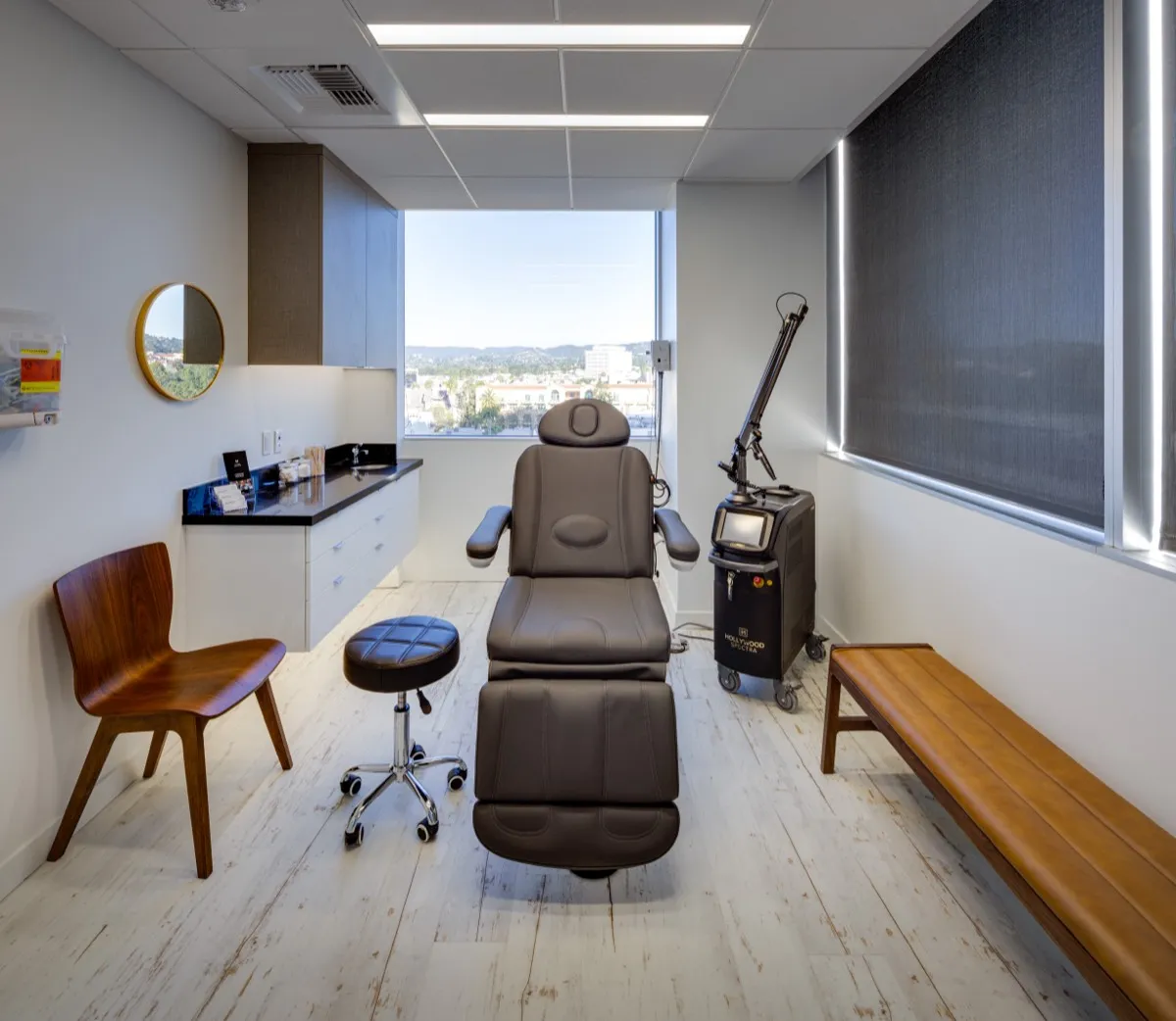
Genius RF microneedling in Los Angeles.
Genius is a radiofrequency microneedling system made by Lutronic, now part of Cynosure Lutronic. Its standard tip carries 49 very fine needles that deliver bipolar radiofrequency energy below the skin's surface, and it is FDA-cleared under two 510(k) clearances, from 2018 and 2026.
At Metropolis Dermatology, Genius RF microneedling is offered in Los Angeles at our Downtown LA and Brentwood offices, in Pasadena, and in San Jose. Our Costa Mesa office uses a different RF microneedling system.
Depth and technique matter more than the basic concept suggests. Treatment should be adjusted for the concern, anatomical area, and skin type rather than performed at one standard setting.
49 needlesOn the standard tip, in a 7 by 7 grid, each about 0.2 mm wide
FDA-cleared510(k) K180945 (2018) and K253484 (2026)
4 officesDowntown LA, Brentwood, Pasadena, San Jose
Skin typeGenius studies included types I to IV
For the full treatment plan, preparation, aftercare, and PRP, see our page on RF microneedling.
Is Genius FDA-cleared?
Genius was first FDA-cleared on December 10, 2018 (510(k) K180945) for use in dermatologic and general surgical procedures for electrocoagulation and hemostasis.
A newer version was cleared on June 29, 2026 (510(k) K253484) for electrocoagulation, contraction, and hemostasis. In plain terms, the clearance covers using the device's heat to coagulate tissue, which its newer clearance describes as electrocoagulation and contraction, and to stop bleeding; skin tightening is not named as a cleared use.
Neither clearance names acne scars, wrinkles, texture, pores, or skin laxity, and in the 2018 filing Lutronic removed treatment of facial wrinkles from the device's indications. Using Genius for those concerns is not a cleared use. Your dermatologist will explain what the published evidence does and does not show for your concern.
Energy devices like Genius are FDA-cleared through the 510(k) process, not FDA-approved. Neither Genius clearance names any skin types.
In October 2025, the FDA reported that serious complications, including burns, scarring, fat loss, disfigurement, and nerve damage, have occurred with certain uses of RF microneedling devices. The FDA advises choosing a licensed provider trained on the device and asking which device will be used. It also states that RF microneedling is a medical procedure, not a cosmetic treatment, and that these devices should not be used at home.
At Metropolis, RF microneedling is provider administered and never a device you use at home.
FDA records checked November 8, 2026.
How Genius RF microneedling works.
Genius combines microneedling with radiofrequency energy delivered beneath the skin's surface. The clinician selects the treatment depth based on the anatomy and concern being treated. During treatment, the system monitors tissue impedance and adjusts energy delivery in real time. This feedback helps account for differences in tissue resistance rather than delivering the same energy indiscriminately across every area.
Heat below the surface
Radiofrequency energy passes through the needles and heats the tissue around the part of each needle that is not insulated, below the skin's surface.
Depth set by your clinician
Needle depth, power, and timing are chosen for each area, from 0.5 mm up to 3.5 mm on the original system and up to 4.0 mm on the 2026 version.
Energy that responds to your skin
Impedance is the skin's resistance to the energy. The system reads it during treatment and adjusts the energy it delivers.
A repair response
That controlled heat injury starts a repair process that increases collagen and elastin. You may begin to see visible improvements after a few weeks, and the change builds over several months as the skin continues to regenerate. The number of treatments depends on your skin goals; a typical plan is 3 to 4 treatments spaced 4 to 6 weeks apart, and in the 2026 Genius study of the lower face and neck most patients had one or two sessions. Your provider sets your plan at your consultation.
The two Genius clearances, side by side
| Feature | Original Genius (2018) | Genius (2026) |
|---|
| FDA 510(k) | K180945, December 10, 2018 | K253484, June 29, 2026 |
|---|
| Cleared for | Electrocoagulation and hemostasis | Electrocoagulation, contraction, and hemostasis |
|---|
| Clearance issued to | Lutronic Corporation | Cynosure Lutronic Technology Corporation |
|---|
| Needle tips | A 49-needle tip in a 7 by 7 grid | 49-needle tips in a 7 by 7 grid, plus smaller tips with 14, 16, or 25 needles |
|---|
| Needle width | About 0.2 mm | About 0.2 mm |
|---|
| Needle depth | 0.5 to 3.5 mm | Up to 4.0 mm |
|---|
| Pulse length | 10 to 1,000 milliseconds | 10 to 600 milliseconds |
|---|
| Skin cooling | Compatible with a cold air chiller | Compatible with a cold air chiller |
|---|
Both versions are compatible with a cold air chiller, which cools the skin during treatment.
Treatment availability varies by provider and location.
What Genius RF microneedling treats.
Genius may be used for acne scars, uneven texture, enlarged pores, and mild skin laxity.
Each use below is matched to its FDA clearance status and the skin types studied for it.
Uses at Metropolis, the FDA clearance status, and skin type basis
| Use | What it is for | FDA clearance | Skin type |
|---|
| Acne scars | Depressed acne scars | Not a cleared use | Studied in Fitzpatrick skin types III to V, RF microneedling studiesStudied RF microneedling studies |
|---|
| Uneven texture | Rough or uneven skin surface | Not a cleared use | — |
|---|
| Enlarged pores | Pores that look larger than you would like | Not a cleared use | — |
|---|
| Mild skin laxity | Early loosening of the lower face and neck | Not a cleared use | Studied in Fitzpatrick skin types I to IV, Genius studyStudied Genius study |
|---|
| Coagulation and bleeding control | Using heat to coagulate tissue and stop bleeding during skin and surgical procedures | Cleared, K180945 (2018); with contraction, K253484 (2026) | — |
|---|
Skin type: "Studied" means peer-reviewed studies included those types for that use. The laxity mark comes from a 2026 study of Genius itself; the acne scar mark comes from a 2025 review of RF microneedling in general, because no Genius study of acne scars reported skin types. Empty numerals were not covered by the clearance or the studies reviewed, which is not the same as unsafe. "Provider assesses" means no reliable source states a range, so your provider decides with you.
For each treatment plan in full, see laser scar treatment, enlarged pore treatment, and RF microneedling.
What studies of Genius show.
In a 2026 study at a German university hospital, 53 women aged 35 to 75 with aging skin of the lower face and neck were treated with Genius, alone or together with a 1927 nm thulium laser (LaseMD Ultra). Both groups had less fullness under the chin and less laxity at follow-up, measured up to 6 months, and no serious side effects were reported.
In the same study, adding the laser improved uneven pigment; with Genius alone, the change in pigment was not significant. Most patients had one or two Genius sessions. The study was not randomized, most patients had skin types I to III, and the authors call for larger studies to confirm the results.
Two smaller Genius studies, in 11 Korean patients treated around the eyes and in 23 older adults treated on the forearms, reported no serious side effects; the skin types reported were III and IV.
The 2026 FDA filing states that no clinical tests were performed for that clearance.
Studies of Genius itself have included skin types I to IV. We found no Genius study that included types V or VI. Reviews of RF microneedling as a whole include more people with darker skin, mostly types III to V, and report a low risk of scarring or darkening, though many of those studies were not of strong quality.
Is Genius RF microneedling right for you?
Often a good fit
- Depressed acne scars
- Uneven texture
- Enlarged pores
- Mild skin laxity
- Someone who wants a middle ground between gentle treatments and a deep resurfacing laser with a week or more of recovery
Not a fit, or tell us first
- An active infection, eczema, a rash, or sunburned or tanned skin in the area: wait until it settles
- Cold sores in the area: tell us, so an antiviral can be started beforehand
- A bleeding disorder, or taking a blood thinner: tell us first
- A tendency to form keloids or raised scars, or dark marks after skin injury: tell us first
- Pregnancy or breastfeeding: tell us first
- More advanced skin laxity, where surgery may serve you better
These treatments can create meaningful improvement, but they do not reproduce the result of surgery.
Genius or another device?
Technology provides options. Knowing which device to use, and how to use it, is what makes those options meaningful.
Our options for scars, texture, pores, and laxity, compared
| Option | How it works | Good to know |
|---|
| Genius RF microneedling | Microneedling with radiofrequency energy delivered beneath the skin's surface | A middle ground option for texture, scarring, and mild laxity |
|---|
| Density RF and Oligio X | Monopolar radiofrequency heats deeper tissue without breaking the skin's surface | Generally suit mild to moderate laxity rather than replacing surgery |
|---|
| Spectra MDF | Fractional laser treatment with less recovery than traditional ablative CO2 resurfacing | Selected concerns involving texture, scars, pores, and uneven tone |
|---|
| LaseMD Ultra | A nonablative fractional laser that creates a controlled pattern of microscopic treatment zones | Pigmentation, sun damage, uneven tone, texture, and overall skin quality |
|---|
| eCO2 and EdgeOne CO2 | Fractional ablative CO2 lasers designed for more significant resurfacing | Downtime is often a week or longer |
|---|
| Microneedling | Fine needles create controlled microinjuries at a carefully selected depth | Can improve acne scars, uneven texture, enlarged pores, and fine lines |
|---|
The right treatment is not automatically the strongest one. It is the one that appropriately balances the amount of correction your skin needs with the downtime, risk, and recovery you can accommodate.
In Costa Mesa, RF microneedling is done with a different system. All our technology.
Genius RF microneedling risks and side effects.
Most reactions are short-lived. This list is not complete.
| Effect | What to know |
|---|
| Redness and swelling | Expected. In the 2026 Genius study, every patient had redness and swelling right after treatment, which settled within a few days. |
| Small bumps or a grid pattern | Bumps where the needles entered are common for 24 to 48 hours. A faint grid pattern can last 1 to 2 weeks after higher energy settings. |
| Bruising | Possible, especially in sensitive areas. One patient in the 2026 Genius study had a bruise near the eye socket. |
| A rash around the mouth | Four patients treated with Genius alone in the 2026 study developed a rash around the mouth (perioral dermatitis), which cleared on its own within a few days. |
| Darkening or lightening of the skin | Mainly a concern on darker skin. In a 2025 review of RF microneedling, temporary darkening was reported in 7 of 16 studies and faded during follow-up. |
| A burn, a new scar, a sunken area, numbness, or weakness | Call us right away. The FDA has received reports of burns, scarring, fat loss, disfigurement, and nerve damage with certain uses of RF microneedling. |
Shaded rows need prompt care.
The technology may be different, but the same principles apply: diagnosis, patient selection, treatment depth, technique, and an understanding of how different skin tones respond.
What to expect before, during, and after a session is on our RF microneedling page.
Questions patients ask about Genius.
What is Genius RF microneedling?
Genius combines microneedling with radiofrequency energy delivered beneath the skin's surface. The clinician selects the treatment depth based on the anatomy and concern being treated. It is made by Lutronic, now part of Cynosure Lutronic.
Who makes Genius?
Lutronic, now part of Cynosure Lutronic. The 2018 FDA clearance was issued to Lutronic Corporation, and the 2026 clearance to Cynosure Lutronic Technology Corporation.
Is Genius FDA-approved?
Energy devices like Genius are FDA-cleared, not approved. Genius is cleared for electrocoagulation, contraction, and hemostasis; using it for acne scars, texture, pores, or laxity is not a cleared use. Your dermatologist will explain what the evidence shows for your concern.
Does Genius set the needle depth by itself?
No. The clinician selects the treatment depth based on the anatomy and concern being treated. During treatment, the system monitors tissue impedance and adjusts energy delivery in real time.
How deep do the Genius needles go?
From 0.5 mm up to 3.5 mm on the original system, and up to 4.0 mm on the 2026 version.
Is Genius suitable for darker skin?
The FDA clearances name no skin types. Studies of Genius itself included skin types I to IV, and reviews of RF microneedling in general mostly included types III to V, with a low risk of scarring or darkening reported in studies that were often not of strong quality. Treatment should be adjusted for the concern, anatomical area, and skin type rather than performed at one standard setting.
How is Genius different from Density RF or Oligio X?
Genius delivers radiofrequency energy through fine needles beneath the skin's surface. Density RF and Oligio X use monopolar radiofrequency energy to heat deeper tissue without breaking the skin's surface, and generally suit mild to moderate laxity rather than replacing surgery.
How many Genius sessions will I need?
It depends on your concern. In the 2026 Genius study for the lower face and neck, most patients had one or two sessions. Your provider sets your plan at your consultation.
Is Genius available in Costa Mesa?
Genius is at our Downtown LA, Brentwood, Pasadena, and San Jose offices. Our Costa Mesa office uses a different RF microneedling system.
How much does Genius RF microneedling cost?
Cost depends on the areas treated and the number of sessions your plan needs, so we quote it at your consultation, before treatment.
How do I start?
You do not need to know which product, laser, or procedure to choose before you arrive. That is our job. Tell us what you notice, what you want to change, and how much downtime you can accommodate. Treatment availability varies by provider and location.
Sources: FDA 510(k) K180945, Lutronic Genius, FDA 510(k) K253484, Lutronic Genius, FDA safety communication on RF microneedling, Nguyen et al., Genius with and without a thulium laser (2026), Kim et al., periorbital Genius study (2023), Baek et al., Genius forearm study (2022), and peer-reviewed reviews in Clinical, Cosmetic and Investigational Dermatology (2025), Dermatologic Surgery (2023), Aesthetic Surgery Journal Open Forum (2023), and Journal of Cosmetic Dermatology (2024). FDA records checked November 8, 2026.