What a laser can do
Melasma laser treatment in Los Angeles and San Jose: what a laser can and cannot do.
Melasma causes darker patches and spots on the face, usually on the cheeks, forehead, chin, or above the upper lip. It is much more common in women than in men, and most likely in women with medium to dark skin tones.
We treat melasma conservatively, using carefully selected devices and settings when appropriate. Laser treatment is usually only one part of the plan, which may also include sun protection, prescription medication, and gentle, barrier-supporting skincare. With melasma, consistency and patience are often more effective than intensity.
A laser does not cure melasma. Treatment can fade it, but melasma can last for years and can come back, so the plan continues after the patches fade.
FirstDaily sun protection and a prescription cream
Then, for someA laser, added to that care, not in place of it
3 to 12 monthsThe usual time to see results from a treatment plan
Can returnMaintenance is part of every melasma plan
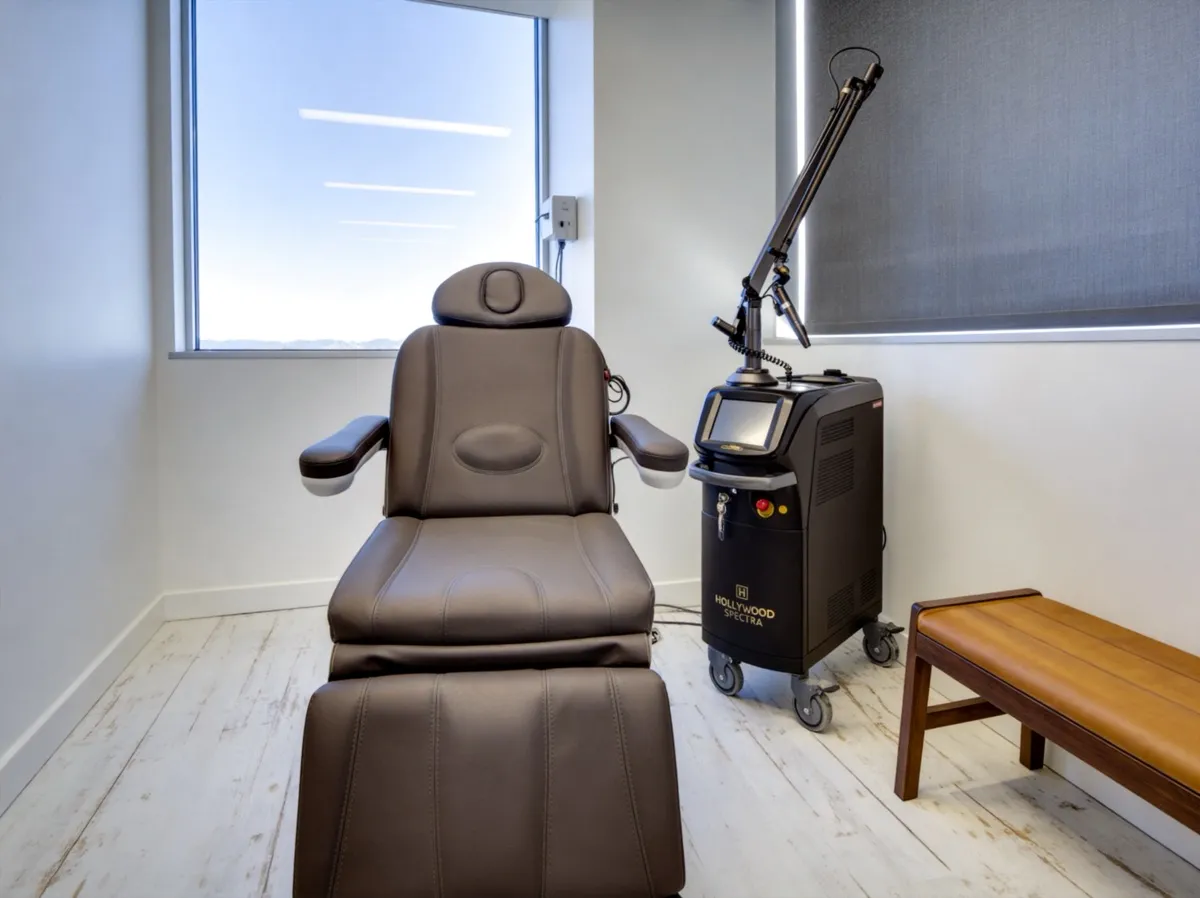
Hollywood Spectra, one of the lasers FDA-cleared to treat melasma, is at our Downtown Los Angeles, Brentwood, Pasadena, and San Jose offices; in Costa Mesa, ask the office how melasma is treated there. Our San Jose office has particular depth in melasma.
Not sure the patches are melasma? Melasma, pigment and sun spots explains how melasma differs from ordinary sun damage, which needs a different treatment strategy.
Before any laser
Melasma treatment starts with sun protection and prescription creams.
Treatment usually begins with sun protection and creams applied to the melasma. Some people need a prescription-strength cream, a procedure, or both.
Dermatology reviews describe creams as the first-line treatment for melasma and lasers as a later option, mainly for melasma that has not responded. When a laser is used, it is added to sun protection and medication, not used in their place.
Flat brown patches across the cheeks, forehead, or upper lip may be melasma rather than ordinary sun damage. The two conditions require different treatment strategies, and treating melasma too aggressively can make the pigmentation worse.
First-line melasma care, before and alongside any laser
| Step | What it involves | Good to know |
|---|
| Daily sun protection | Broad-spectrum sunscreen, SPF 30 or higher, reapplied every two hours outdoors, and a hat with a UPF label | Sunlight makes the skin produce more pigment, which can darken melasma and cause new patches |
|---|
| Tinted sunscreen | A tinted sunscreen with iron oxide, SPF 30 or higher | Visible light can worsen melasma, especially in darker skin tones |
|---|
| Hydroquinone | A common prescription cream, sometimes combined in one cream with tretinoin and a mild steroid | No longer sold without a prescription in the United States (checked 8 November 2026) |
|---|
| Other prescription creams | Tretinoin with a mild steroid, or gentler options such as azelaic acid, kojic acid, or vitamin C | Your dermatologist tailors the choice to your skin |
|---|
| Tranexamic acid | A cream, or a pill usually taken twice a day | In studies, it lessened melasma when other treatments had not worked; not suitable for everyone (below) |
|---|
| Gentle skincare | Fragrance-free products that do not burn or sting | A product that burns or stings is irritating your skin |
|---|
Tranexamic acid tablets are FDA-approved for heavy menstrual bleeding, not for melasma. Their label rules them out with combined hormonal birth control or a history or risk of blood clots, so tell your dermatologist about both before starting. Label checked 8 November 2026.
When you follow the plan, results usually take 3 to 12 months. Your dermatologist may suggest makeup to cover the patches until they fade.
How it works
How melasma laser treatment works.
Low energy, a wide beam
Melasma laser toning uses a Q-switched 1064 nm Nd:YAG laser at low energy, with a wide beam, over a series of sessions, usually around ten.
Breaks up the pigment granules
The very short pulses break up the pigment granules (melanosomes) while leaving the pigment-making cells alive.
Heat is the risk
Melasma reacts to heat and inflammation, so the energy is kept low. Too much total energy can cause pale spots or darker patches.
Added to creams
A laser is added to sun protection and prescription creams. In studies, adding skincare or, for some patients, medication generally lowered side effects, though it did not always improve results.
Each device has a different purpose. We select the technology, wavelength, depth, and settings based on your skin rather than asking your skin to fit a particular device.
Our melasma lasers
Lasers for melasma we use, and what each is FDA-cleared for.
Lasers are FDA-cleared, not FDA-approved: the FDA found each device equivalent to one already on the market, for the specific uses named in its clearance. Where melasma is not named, we say so.
- Hollywood SpectraStudied in Fitzpatrick skin types II to V, melasma toningStudied melasma toning Hollywood Spectra is a versatile pigment-focused laser. By changing the wavelength, handpiece, and settings, we can address concerns such as unwanted pigmentation, uneven tone, and selected tattoos. Made by Lutronic. FDA-cleared in February 2022 (510(k) K213569) for the treatment of melasma with its 1064 nm beam. The clearance names no skin types. Available at: Downtown LA, Brentwood, Pasadena, San Jose.
- LaseMD UltraLaseMD Ultra is a nonablative fractional laser that creates a controlled pattern of microscopic treatment zones while leaving the surrounding skin intact. It can be used for pigmentation, sun damage, uneven tone, texture, and overall skin quality. Made by Lutronic. Its FDA clearances (K171009, June 2017, and LaseMD LEO, K192331, November 2019) name benign pigmented lesions such as age spots, sun spots, and freckles. Melasma is not named, so treating melasma with it is not a cleared use. Available at: Downtown LA, Brentwood, Pasadena, San Jose.
FDA clearance status checked against FDA 510(k) records on 8 November 2026. Every device we use
Is it right for you
Who melasma laser treatment suits, and who should wait.
Often a good fit
- Melasma confirmed at a dermatology exam
- Already using sun protection and a prescription cream, and wanting more improvement
- Melasma that has not improved enough with creams alone
- Ready for a series of sessions and ongoing maintenance
Not a fit, or wait
- Pregnancy: wait until after your baby is born
- A spot that is new, changing, or bleeding: we examine it before any laser
- A tan or sunburn on the day of treatment
- Melasma that is flaring, or was made worse by past treatment
- Medicines or skincare that make skin more sensitive to laser light: tell us everything you use
The first step is an accurate diagnosis. The exam comes first. The treatment plan follows.
Darker skin tones
Melasma laser treatment for darker skin tones.
Skin conditions do not always look or behave the same across skin tones. Melasma, post-inflammatory pigmentation, acne, keloids, and even skin cancer may present differently, and the same treatment settings are not appropriate for every patient.
Melasma develops more often in medium and dark skin tones. Treating it in darker skin takes a different approach, because some melasma treatments can irritate darker skin, which can worsen melasma and make it darker.
Lasers have long been used cautiously for melasma, because heat and inflammation can stimulate more pigment, especially in darker skin. Even low-energy laser toning, used aggressively, can leave darker patches, and darker skin is more prone to burns and dark marks after laser treatment.
One review notes a likely higher risk with Q-switched lasers in skin types IV and V, and a very high risk of both darker and lighter marks with ablative fractional lasers, which are used for melasma only with caution.
Not every laser is appropriate for every skin tone. We selected a range of wavelengths and technologies so we can choose a safer, more appropriate option rather than forcing one platform to do every job.
If the treatment you requested is not appropriate for your skin, we will explain why and recommend a safer or more effective alternative.
Related: Dark marks after a breakout
Skin types on the Fitzpatrick scale, from I (lightest) to VI (deepest). Filled numbers are the types each treatment is cleared, treated, or studied for. Ranges for a treatment in general and for a specific device can differ, because they come from different studies. Your provider confirms the right approach for your skin at your visit.
Your plan
What a melasma treatment plan involves.
DiagnosisWe confirm it is melasma rather than sun damage, because the two are treated differently
FirstDaily sun protection, including tinted sunscreen, and a prescription cream
If a laser is addedIn studies, usually about 9 to 10 low-energy sessions, weekly or every two weeks, alongside skincare
ResultsUsually 3 to 12 months when you follow the plan
AfterwardSun protection and maintenance continue, because melasma can come back
Risks
Melasma laser treatment risks and side effects.
What to know before laser treatment for melasma. This list is not complete; your provider reviews the risks for your device and skin.
| Effect | What to know |
|---|
| Redness after treatment | Expected for a short time after treatment. |
| Darker patches | Aggressive treatment can darken melasma or leave dark marks, especially in darker skin. |
| Light spots | With repeated melasma toning, small pale spots can develop and persist; about 10% in studies of East Asian patients, more often in darker skin and with too much total energy. We use spacing and settings to limit this. |
| Burns | Darker skin is more prone to burns and dark marks after laser treatment. |
| Melasma coming back | Melasma often returns after treatment stops; in one study, about 59% had relapsed at one year. Ongoing sun protection and skincare matter. |
Other options
Other melasma treatments, and when they fit better.
Melasma treatments that are not lasers
| Treatment | Where it fits | Good to know |
|---|
| Sun protection and tinted sunscreen | Every melasma plan | Helps fade melasma and keep it from returning |
|---|
| Prescription creams | First-line treatment | Hydroquinone, often with tretinoin and a mild steroid, or gentler creams |
|---|
| Tranexamic acid | Melasma that has not responded to other treatment | A cream or a pill; the pill is not for everyone |
|---|
| Chemical peels | Removing excess pigment | Offered at all five offices |
|---|
| Sunspot removal | Sun spots, which are not melasma | The two are treated differently |
|---|
| Makeup to cover the patches | While a treatment plan takes effect | Results usually take months |
|---|
Related: Melasma treatment
Questions
Melasma laser treatment questions.
Can a laser get rid of melasma for good?
No. Treatment can fade melasma, but treatments cannot make it go away forever, and it can come back. Daily sun protection and maintenance help keep the improvement.
Can a laser make melasma worse?
Yes. Melasma is especially sensitive to heat and inflammation, and aggressive laser treatment can leave it darker than before, especially in darker skin. That is why a laser comes after sun protection and creams, at low energy and with careful spacing.
Which laser treats melasma?
Hollywood Spectra is FDA-cleared to treat melasma with its 1064 nm beam, used at low energy over a series of sessions, often called laser toning. The vascular lasers DermaV, V-Laser, and Clarity II are also cleared for chloasma, another name for melasma. Melasma is not named in the clearances for LaseMD Ultra or for the pico lasers checked. Our melasma lasers
Do I still need creams if I have laser treatment?
Yes. The studies that found a laser can improve melasma added it for patients already using medication on their skin and protecting it from the sun.
How many laser sessions will I need for melasma?
In studies, usually about 9 to 10 low-energy sessions, weekly or every two weeks. Your plan is set at your consultation.
Will my melasma come back?
It may. Melasma often returns after treatment stops; in one study, about 59% had relapsed at one year. Daily sun protection and maintenance skincare are part of the plan.
Can melasma on the upper lip be treated?
Yes. The area above the upper lip is a common place for melasma, and it is planned the same way as the cheeks and forehead: diagnosis, sun protection, and prescription cream first, with a laser added for some patients.
Is melasma laser treatment safe for darker skin?
It can be done carefully, with the device and settings chosen for your skin. Melasma is more common in medium and dark skin tones, and darker skin is more prone to burns and dark marks after laser treatment, which is why skin type comes first in the plan. Darker skin tones
Can I treat melasma while pregnant?
Wait until after your baby is born. Pregnancy can trigger melasma, and it can fade after delivery.
Is melasma treatment covered by insurance?
Insurance is accepted for eligible medical care. Health insurance generally does not cover cosmetic treatments, so our team confirms costs before your first session.
How much does melasma laser treatment cost?
Plans and costs are set at your consultation, once we know what you want to change and which treatments fit.
Sources: FDA 510(k) clearances for Hollywood Spectra, LaseMD, Pico Majesty and Boston Pico; American Academy of Dermatology on melasma, melasma treatment, melasma self-care and lasers; Lee and colleagues, 2022; Trivedi and colleagues, 2017; FDA label for tranexamic acid tablets.